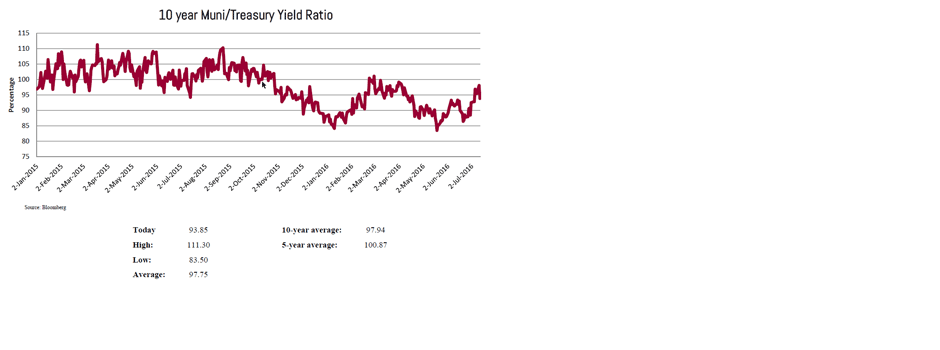
We have provided some color about the current state of the bond market below:
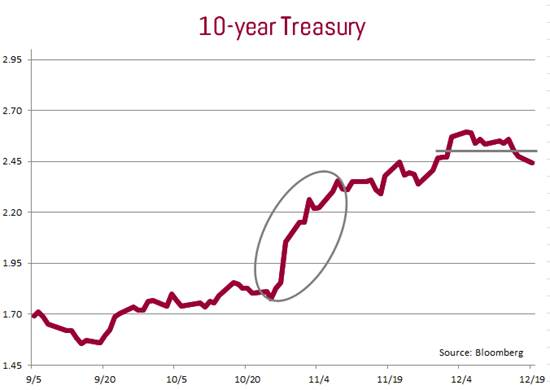
Worldwide interest rates have declined in the aftermath of the Brexit vote. The bond market rally continued through Monday, June 27th, with the taxable 10-year U.S. Treasury yield declining to 1.43%.
The process of the UK leaving the EU will take time. This will create uncertainty and therefore, volatility in the financial markets. We do not expect interest rates to increase dramatically in the short term, absent an extraordinary macro event.
In this type of environment, the laddered bond portfolio structure is a sound investment strategy:
– Its fundamental discipline requires re-investment of maturing bond proceeds and interest payments
– Its staggered maturity structure and consistent interest payment dynamic ensures a degree of portfolio liquidity, as funds are regularly available for reinvestment.
– The strategy allows you to capture higher yields on the long end of the ladder.
A derivative strategy many of our portfolio managed clients are using in this low rate environment is our “Short Duration” strategy. This strategy invests assets in shorter term issues currently earning between 0.50% to 1.00% yields not subject to current federal income taxes. These yields approximate to taxable equivalent yields of 0.82% and 1.65% for a taxpayer in the top federal income tax bracket.
Municipal bonds continue to look attractive compared to other traditional safe haven investments, given recent stock market volatility and continued easy monetary policy around the world. A recent Bloomberg Municipal Market Brief confirms the sentiment:
“The muni market looks attractive and considerably safer,” said Frank Shafroth, the director of the Center for State and Local Leadership at George Mason University in Fairfax, Virginia. “Safe and trusted”.
Please call your Investment Specialist or Portfolio Manager with any questions.
Thank you for your continued confidence in our portfolio management team.
Sincerely,
Thomas P. Bernardi, CFA
Our descriptive Three Pillars is an over generalization of our approach to municipal credit analysis. When we look under the hood of each bond, numerous variables come into play, including: State statutes, taxing capacities and limits, the real or perceived unsecured status of the lien, political trends, and many others. This is what makes investing in municipal bonds laborious and nuanced – but fun – and financially fulfilling for your portfolio when the work is done effectively. It also demonstrates the importance of active management in a market where not all bonds are created equal.
Another variable that impacts our opinion of a credit, and its relative trading value, is the long term demographic trends of the municipality or surrounding region. The U.S. Census Bureau [1] provides great insight into current trends.
It is no surprise where most of the growth is occurring: Texas, Arizona, California and Florida. Actually five of fifteen the fastest growing cities (above 50k people) are located in Texas.

The southwest and snowbird states are not the only areas that have solid demographic trends. Take Ankeny, IA for example, which experienced the third fastest growth rate in the nation. Ankeny is a suburb of Des Moines and the current population of 56,764 is up 11,182 since 2010. It has more than doubled the last 15 years. Murfreesboro, TN and Mount Pleasant, SC are two other notables that have benefited due to their proximity to budding cities. Murfreesboro is a Nashville suburb – which is now the largest city in Tennessee after surpassing Memphis- while Mount Pleasant, SC abuts Charleston.
A city experiencing explosive growth needs to be looked at closely, however. Sometimes the level of growth is a temporary factor, while politicians’ growth assumptions are more permanently baked into projections and fixed costs. Should growth subside, the resulting structural deficit is not always easy to cure politically and financially.Chicago’s pension liability is a recent and relevant example of how projections do not always hold up and the resulting structural inadequacies that follow inaccurate projections. Due to underfunding, generous benefit structures, and subpar investment returns, the city is faced with a significant liability. Also, it is the only city in the largest 15 to lose residents last year – losing 2,890 people.

Of the sixty largest cities, seven lost population. Five of the seven are located in the Midwest.

Detroit experienced over 40 years of 1.70% annual population decline[2] before it faced bankruptcy in 2013. This demonstrates that the trends are important, but not necessarily a near-term worry for cities that have conservatively managed their budget. For cities like Chicago – and even still Detroit – population decline will add further pressure to already stressed financial situations.
That being said, the other five cities that experienced population decline last year are all approved credits. Though one aspect (population trend) of the “Underlying Credit Quality” Pillar is weak, these cities have been able to balance their finances. We also look to the other two pillars (structure and purpose) to provide relative strength due to weakness in the demographic trends.
I hope you find this commentary helpful and if you have any comments or questions, please do not hesitate to contact your Investment Specialist or Portfolio Manager.
Sincerely,
Matthew P. Bernardi
Investment Specialist
I have spoken to a number of clients recently regarding the impact the Department of Labor’s (DOL) Fiduciary Standard ruling will have on their qualified plans. Even though the DOL ruling only affects retirement accounts, it became clear to me during the course of these conversations that investors are confused about the differences between a Fiduciary Standard and a Suitability Standard. I thought it would be a good idea to offer some clarity on these differences and explain how these standards relate to your account and our portfolio management process.
Bernardi Securities, Inc. (BSI) is a registered broker-dealer, is regulated by Finra/SEC, and is subject to Suitability Standard industry regulations. Bernardi Asset Management (BAM) is a subsidiary of BSI, is a SEC registered investment advisor (RIA) and is subject to Fiduciary Standard industry regulations. We offer both options of bond portfolio management services to our clients.
Many clients choose the BSI bond portfolio management option. Under this platform, clients are charged a one-time mark up and for many investors this option is a more cost effective choice for them. As a broker-dealer, BSI is subject to the Suitability Standard. The Suitability Standard require the broker dealer to deal fairly with investors, perform due diligence to ensure an investment is reasonably suitable for a specific client based upon his or her needs, sophistication, risk tolerance and financial circumstances (Finra rule 211). We utilize the BSI Investor Profile, Bond Offering Profile and Statement of Understanding documentation as a step in our process to help ensure we are meeting and exceeding our suitability requirements for client relationships held through our broker-dealer arm. Additionally, BSI is also subject to “Know Your Customer Rule” which requires it to know of and understand a client’s financial situation making it more likely an investment recommendation is suitable (Finra 2090). Recent implementation of the Best Execution rule require the broker-dealer to use reasonable diligence to ascertain the best market for the subject security and buy or sell in such market so that the resultant price to the customer is as favorable as possible under the prevailing market conditions ( Finra rule 5310 & MSRB rule G-18). Numerous articles have been written implying that a Suitability Standard is somehow an inferior business model. These rules provide a glimpse of the many industry regulations designed and enforced to protect investors who conduct business through a broker-dealer model.
Similarly, many clients choose the BAM/RIA bond portfolio management option. Under this platform, clients are assessed an annual fee based upon assets under management. As a RIA, BAM is subject to a higher, Fiduciary Standard of care. The Fiduciary Standard requires the investment manager to put their client’s interest ahead of its own, avoid conflicts of interest and fully reveal all compensation for investments it recommends. This platform is the gold standard in our industry and many clients prefer a fee based platform and are willing to pay an ongoing fee for this standard of care.
In either case, both platforms offer our expert bond portfolio management approach to ensure a professional, fair and transparent process. One of our primary goals is to offer our investors a choice because “one size does not fit all”. I would urge you to contact your investment specialist to discuss our various bond portfolio management options to determine which option is best suited for your needs. As Chair of our Standards Committee, I can assure you whether you are a client through BSI or BAM, we are continually evaluating and adapting our processes in order to meet industry changes, reviewing and resolving any potential conflicts of interests and always striving toward a common goal of aligning our interests with the interests of our clients.
Thank you for your continued confidence in Bernardi Securities, Inc. and Bernardi Asset Management.
Sincerely,
Michelle Bernardi
Senior Vice President
Market Update: Municipal bond yields decreased during the first quarter with AAA 5- year, 10-year, and 20-year yields falling 15, 18, and 8 basis points, respectively. In March, the Federal Reserve announced that their pace of interest rate increases was likely to be slower than initially expected. It anticipates two rate increases this year, down from the initial four predicted. Slower growth abroad and market volatility were reasons for the reduction in rate rising estimates.
Are you thinking of selling some of your bonds?
Selling bonds is an infrequent exercise for most retail investors and even many institutional clients.
A vexing question for many is, “How do I know I am getting a fair market price for my bonds?” At many firms in our industry, the sale process is needlessly opaque and confusing.
Years ago we realized this as an industry shortcoming so we developed and implemented a transparent and cost efficient “bid wanted“ process. We believe this process is superior because it ensures the transparency and efficiency our clients seek.
Here is a snapshot summary of our process when clients sell bonds through our trading desk: Our trading desk will put your bonds out for bid on one or more of the available, nationwide, bid wire services ensuring your holding will receive nationwide attention. After a couple hours ‘on the wire’ the bids are reviewed and our trading desk may or may not bid the bonds.
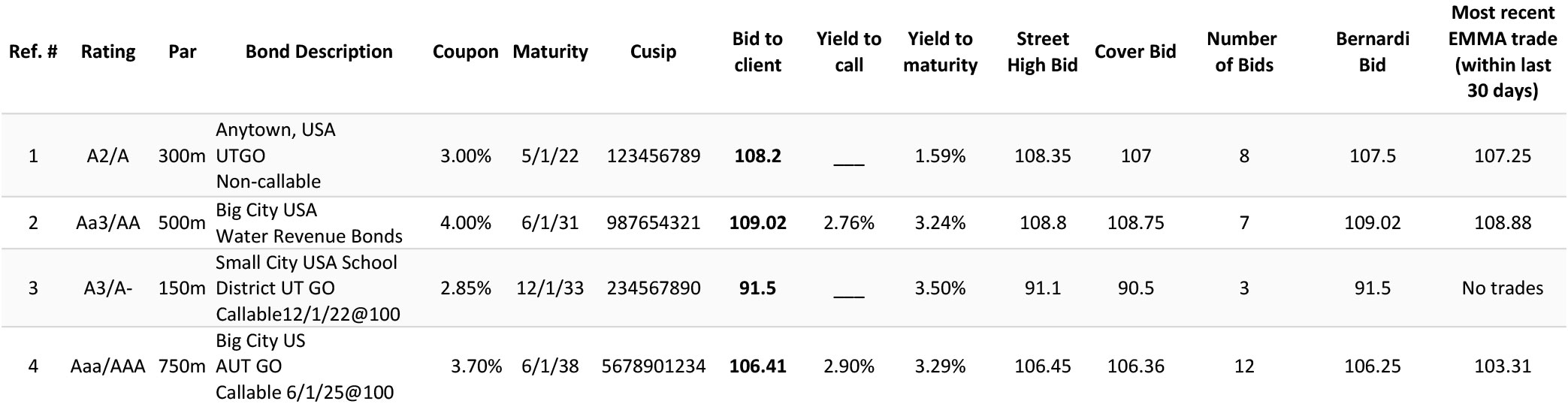
The results are input to our bid template and then sent to the client for review. A sample of this template is shown below:

There are several things this transparent bid report reveals:
- The number of bids each CUSIP receives.
- The second place (or cover) bid and how far behind it is relative to the high bid. We often then add color as to what we think this means.
- Whether or not Bernardi Securities, Inc, trading desk is bidding the bonds.
- Our public mark–down schedule clearly enumerates our gross profit (your cost) we charge to run bid process for issues sold to the high street bid.
- If the CUSIP has recently traded, the report shows if the received bids are representative of current market levels. Are the bids fair?
These are all valid and important questions and for these reasons we developed and implemented this practice several years ago.
Our goal is to make the sale process as transparent as possible. Given the arcane nature and many nuances of the municipal bond market, we believe our method provides excellent execution for our clients.
If you are thinking of selling or if you need price discovery for regulatory purposes, we ask that you call us and we can discuss our process in greater detail.
IDES OF MARCH 2016 – ET TU, PUERTO RICO?
The Ides of March, the 15th of the month, represents the monthly midpoint of the Roman calendar. Julius Caesar was assassinated on the Ides in 44 BC by his friend Marcus Brutus and others. As he lay dying, Caesar uttered these words to his friend, “Et Tu, Brute?” (You, too, Brutus).
Caesar’s assassination transformed Roman history – it was the central event in marking the transition from the Roman Republic to the Roman Empire.
Which brings me to today’s topic – Puerto Rico’s financial state and the repercussions for the municipal market.
The financial chaos unfolding in the island paradise, El Borinquen, may prove to be transformative for bond investors’ psyche – just as Caesar’s demise changed the arc of Roman history.
Here is our premise: if Puerto Rico attempts and succeeds in treating the interests of General Obligation bond investors in a cavalier fashion similar to the way Detroit succeeded, the repercussions for average and below average quality municipal issuers will be negatively impacted. Some in this group will lose access to public capital markets, while others will have access at an inflated cost that is paid by local tax and rate payers.
Issuers in these groups (Chicago Public Schools, for a recent example) are typically more dependent on the capital markets than stellar credits. Liquidity is often an issue and the bond market provides the liquidity they seek. Generally speaking, Detroit’s treatment of general obligation bonds has created doubt in the minds of investors. Many are closely watching how Puerto Rico acts.
Continuing with our Caesarean analogy, we wonder if Puerto Rico and the municipal market are at the banks of the Rubicon and ask, Et Tu, Puerto Rico?
In the following pages we discuss:
- Puerto Rico
- Detroit’s reality post Chapter 9
- A Congressional role in Puerto Rico
- Ideas to improve investor confidence
- Strength of the municipal market
PUERTO RICO IS NOT DETROIT
Detroit’s court approved plan is not a template for a solution to Puerto Rico’s problems because:
- Puerto Rico cannot file for bankruptcy; some have asked Congress to grant it this power. Congressional sentiment on the issue is divided.
- Puerto Rico’s problems are different; debt structure, security pledges, pension issues are not the same.
- Some in the island’s leadership have stated they want to honor payments to general obligation and revenue bond investors and that a debt repayment waterfall structure is needed. Detroit’s position was the polar opposite and problems persist post-bankruptcy because the unfunded pension issue was not resolved. (i)These comments are thoughtful and a good starting point, acknowledging the devil lies in the complicated details. Puerto Rico needs affordable investor capital (absent a federal bailout) to help it successfully emerge from its crisis.
A DIRECTION of ORDER is IN ORDER
All stakeholders must come to the table in order to enact an orderly restructuring.
The problems for the island exist both due to its cost-structure and level of financial liabilities. Therefore, every constituency, debtor and creditor, will need to make concessions in some form. Giving Puerto Rico broad, unilateral powers through bankruptcy, without any oversight to write down its debt, while favoring public pensions, would be a mistake. In the long run, this approach will harm its citizens, its investors and the broader market.
Clarity and guidance on certain issues is needed and it seems to us that Congress is the body to provide it. Its leadership will better ensure an orderly and sensible re-structuring plan for Puerto Rico.
Why should Congress get involved?
- Chapter 9 law, to a great degree is being written now. Legal precedent is scant. Bankruptcy judges in Stockton, Detroit and San Bernardino have been reluctant to interject their legal solutions.
A federal judge’s power in Chapter 9, while significant is limited to making narrow determinations. The judge cannot order a municipality to raise taxes, as an example. Judges Klein (Stockton) and Rhodes (Detroit) avoided altering the debtors’ plan. Judge Rhodes offered guidance by stating Constitutional protections did NOT protect pensioners’ contractual rights in bankruptcy, but chose not to alter Detroit’s plan that clearly protected pensions over general obligation bond creditors. If judges in future Chapter 9 cases fail to add legal clarity to the process – outcomes for investors will not be good.
Congress can clarify a great deal by establishing statutory precedent in Puerto Rico’s situation. Its statutory methodology could serve as a template for other distressed situations.
2. There is no uniformity in Chapter 9, so generalizing about solutions is difficult. There are 50 states with different laws. There is no Uniform Commercial Code in the municipal space. This was problematic in Detroit, San Bernardino, and Stockton because the debtor (distressed municipality) unilaterally files its re-organization plan, which drives the mediation process. If the judge takes a hands-off approach, it is up to a creditor group to negotiate the best deal it can. There is no transparency in these mediations, unlike in a courtroom. The entire process is opaque so it is difficult to tell why creditors settled for what they got. Once a deal gets cut in mediation, it is done. It will not be re-cut because another creditor class objects to it.
This lack of clarity and lack of creditor priority is not good for debtors or creditors. Investors that have been jilted by the process will invest their capital elsewhere.
A FEW IDEAS TO GUIDE THE PROCESS
- Make it clear that Special Revenue bonds are inviolate. Detroit initially attempted to cram down losses on this investor group. It backtracked when confronted with litigation, most likely because it knew its position was illegal. The issue, however, was not decided in court. A clear statement on this topic would be helpful.
- Provide guidance regarding “classification” and “unfair discrimination” rules. These are two areas where judges possess significant power in the bankruptcy process. People are uncomfortable being classified as an unsecured creditor because of the lack of protection for this class in the Bankruptcy Code. Stockton placed investor Franklin Funds in the unsecured class, while refusing to do anything to its pensions – it called the shots. The Judge chose not to reverse this unilateral action. Franklin took an approximate 90% haircut in the final settlement. The weakening of “unfair discrimination” rules in the Detroit case is vexing to many. Chapter 9 allows for similar credit classes to be treated differently if there is no unfair discrimination. Judge Rhodes stated it is the judge’s sole discretion to decide this issue provided the disparate treatment does not violate “the moral conscience of the court”. We are unsure of what that means, but we are certain on two points:
-
- The standard is totally subjective.
- The standard is dangerous and makes investors very nervous; as a result, investment capital becomes more expensive for certain issuers.
3. A sensible, defined “waterfall payment” structure for creditors is needed. Creditors in one class should not be threatened with a similar, low recovery when their interests would receive a greater recovery in a hypothetical liquidation. As examples, voter approved, full faith and credit general obligation bond investors have a specific “millage” securing the interest. As long as the tax is collected, why should a bankruptcy plan threaten this class with a haircut so that these monies can be used for other purposes? Going further, general obligation bond investors with a security interest in general fund monies but lacking a specific tax levy may enjoy significant protection but it is diminished compared to the first group. General obligation debt is not monolithic and a debtor’s plan should recognize this fact.
4. Make clear restricted funds and intercept structures are immune from Chapter 9 machinations. Restricted funds should be viewed the same as special revenue and are not the municipality’s property. Similarly, when a municipality agrees to an intercept, its intent is to provide special protection to investors; decisions are made because this mechanism is in place. Both issues remain unsettled.
BERNARDI’S APPROACH – NOT WAITING for GODOT
We have spent many hours studying, discussing and developing a practical approach to these issues. We focus our efforts on a sensible application of our strategy to deal with reality. We and our investor clients do not have the luxury of time waiting for a federal judge or Congress to clarify or solve these issues – acting that way is the bond market’s version of “Waiting for Godot”.
Municipal bankruptcies remain incredibly rare occurrences. Municipal defaults recently have averaged less than 0.04% annually. They usually can be anticipated by periodic, thorough credit analysis. Historically, corporate bonds default at a much higher percentage.
Generally, we remain bullish on municipal bond credit quality because the vast majority of bonds are solid credits. The fact that the market today is more complicated and volatile compared to the past, underscores the importance of our municipal bond market expertise and our belief that sound portfolio management begins with thorough credit research.
We remain steadfast in our focus on the Three Pillars of Municipal bond credit research:
- Underlying credit quality
- Deal purpose
- Deal structure
When we decide a credit is weak in one pillar, we look for strength in the other two. We use different interactive strategies surrounding the three pillars to guide us so that collectively they result in sound credit quality for a particular credit. Our strategies in this area are evolving in response to current events and those we anticipate.
We believe it is difficult to have a “safe” credit in a distressed situation. Our goal is to avoid entirely, suspect credits, but credit quality changes over time. This is a reality of investing.
We do our best to address this dynamic by adhering to our time tested municipal bond credit research process and adjusting it as changing times demand. This is a major component of the value we bring to a client relationship.
After all, if a credit possesses and maintains solid underlying credit quality, essential deal purpose and solid deal structure then the Chapter 9 discussion is moot.
Thank you for your continued confidence in our team. We welcome your comments and inquiries.
Sincerely,
Ronald P. Bernardi
President and CEO
March 16, 2016
(i) Recently Detroit’s mayor, a mere 14 months after emerging from Chapter 9, stated the biggest fiscal threat facing the city is its pension fund deficit – $490 million which must be closed by 2024 as part of the “Grand Bargain” legislation. This legislation drove its bankruptcy plan and ostensibly, solved its financial problems. The approved plan requires the city to contribute $111 million in 2024. The Mayor, in his State of the City speech last month, said the required amount due in 2024 has grown to $194 million.

According to the ICI Institute, municipal bond fund inflows amounted to $857 million for data ending February 24th.[1] This is now twenty-one straight weeks of inflows into municipal bond funds and we are on pace to see the highest annual inflows since 2012. Our firm’s separate account platform is experiencing a similar trend since 4Q15. This flight to quality corresponds to widespread fears of a global slowdown and a potential recession in the U.S. Since the start of this year, the 10-year AA rated municipal bond has fallen in yield (increased in price) from 2.12% to 1.92% today. The 10-year Treasury has fallen from 2.27% to 1.77%.
The flock to high-grade asset classes has largely left corporate bonds by the wayside, as investors consider the massive amount of issuance post-crisis and fear declining profitability metrics going forward. Pressure in the high yield market has spread beyond the distressed oil sector, as well.
We will not dare to speculate if the trend lower will continue, or if this is merely a hiccup in today’s QE-crazed world. We do believe, however, even with the rally in municipals (lower-yields), and spread widening in corporate bonds (higher yields), municipals continue to offer attractive risk-adjusted returns and should continue to play the foundational “mattress-money” role of your overall asset allocation.
Municipals compare favorably on a taxable equivalent basis with similarly rated corporates in the highest income tax-brackets. When you take into account the overall credit health of the high-grade municipal market and much lower historical default rates versus corporates, municipals continue to offer attractive risk-adjusted taxable equivalent returns for investors in the 25-30% income tax brackets, as well.
Corporations have certainly taken advantage of the low-rate environment since the crisis. Bond issuance has skyrocketed. Total corporate par-amount outstanding has grown from $5.25 trillion at the end of 2007 to $8.24 trillion as of 3Q15.[2] This is a growth of 56.97%. This compares to our nominal GDP growth since 2007 of only 23.90%.[3] Municipal issuance, on the other hand, has flat-lined, as many localities have conservatively balanced their books and reduced debt in this low-growth environment. The total par-amount outstanding for municipalities is up only slightly since 2007, going from $3.42 trillion to $3.71 trillion 3Q15.
We will admit the low nominal yields in today’s high-grade markets are frustrating. In many ways it seems investors are buying bonds for two reasons… for consistent cash flows and as insurance given the volatility throughout global asset classes and prices (disinflation/deflation). The low relative yields, however, are a testament to the health of the average municipality and investors’ concerns about other credit markets.
I hope you find this commentary helpful and if you have any comments or questions, please do not hesitate to contact your Investment Specialist or Portfolio Manager.
Sincerely,
Matthew P. Bernardi
Investment Specialist
[1] https://www.ici.org/
[2] http://www.sifma.org/research/statistics.aspx
[3] http://www.bea.gov/national/index.htm#gdp
Market Update: As many market participants anticipated, on Wednesday, December 16th the Federal Reserve announced its first rate hike since 2006 increasing the fed funds rate to a range of 0.25% – 0.50%. Despite the news, municipal bond yields decreased during the fourth quarter with AAA 5-year, 10-year, and 20-year yields falling 2, 11, and 25 basis points, respectively. According to Bloomberg, the market is not projecting a rate hike during the Fed’s January meeting.